TRON Energy for OTC Desks: Large, Irregular USDT TRC-20 Transfers
A 30M USDT transfer and a 1 USDT transfer both used 64,285 energy on Nov 20, 2026. How an OTC desk with uneven deal flow pays for energy.
- Category
- For business
- Published
- Reading time
- 8 min
On TRON, the size of a USDT transfer does not change its network cost: on Nov 20, 2026 a 30,000,000 USDT transfer and a 1 USDT transfer each used 64,285 energy. For an OTC desk, the cost of a deal depends on other things: whether the counterparty’s address holds USDT at that moment, whether a test transfer goes first, and how energy reaches the settlement address when deals arrive unevenly.
Network figures below are as of Nov 20, 2026.
Millions or one dollar: the same energy
A USDT transfer calls transfer on the contract TR7NHqjeKQxGTCi8q8ZY4pL8otSzgjLj6t, which lowers one balance and raises another. The amount is only the number written into those entries, so the energy is the same for any value. What changes it is whether the recipient’s USDT balance is above zero. Receipts from TronGrid gettransactioninfobyid:
| Time (UTC) | Amount, USDT | Recipient held USDT | Energy | Of it, dynamic surcharge |
|---|---|---|---|---|
| Nov 20, 01:10:36 | 30,000,000 | yes | 64,285 | 49,635 |
| Nov 20, 05:19:09 | 500,000 | yes | 64,285 | 49,635 |
| Nov 20, 05:19:09 | 1 | yes | 64,285 | 49,635 |
| Nov 20, 05:19:09 | 250,000 | no | 130,285 | 100,635 |
| Nov 20, 05:19:09 | 1.00002 | no | 130,285 | 100,635 |
| Nov 19, 13:20:06 | 1,100,000 | no | 130,285 | 100,635 |
The four transfers at 05:19:09 sit in one block, 88,159,288. All six also used 345 or 346 bandwidth. Without energy the network burns 100 SUN per unit: 6.43 TRX for each of the first three, 13.03 TRX for each of the last three.
What does change the cost of a deal
The counterparty’s balance at the moment of sending
The 1,100,000 USDT transfer of Nov 19 went to an address the same sender had paid three times in the previous 24 hours. That address’s USDT history explains the prices:
| Time (UTC) | Incoming transfer | Balance just before | Energy |
|---|---|---|---|
| Nov 18, 13:22:03 | 300,000 USDT | above zero | 64,285 |
| Nov 18, 13:26:36 | 1,100,000 USDT | above zero | 64,285 |
| Nov 18, 18:51:00 | 250,000 USDT | zero, forwarded 4 minutes earlier | 130,285 |
| Nov 19, 13:20:06 | 1,100,000 USDT | zero, forwarded the evening before | 130,285 |
Two of four transfers to a known counterparty were priced as transfers to a new address, because the counterparty forwards what it receives. “We paid them yesterday” says nothing about today. A balanceOf read right before sending is free; the call format is in estimating energy with triggerconstantcontract.
The test transfer
A test is a full transfer, but it does not always double the cost:
- Recipient holds USDT: 64,285 + 64,285 = 128,570 energy instead of 64,285.
- Recipient is empty: the test takes 130,285 because it creates the balance, then the main transfer takes 64,285. That is 194,570 instead of 130,285.
Either way the test adds exactly 64,285 energy: 6.43 TRX burned, or 2.19 TRX rented at 34 SUN per unit for 1 hour as of Nov 22, 2026. The exception: if the counterparty forwards the test and leaves zero, the main transfer is priced as new again. Ask them to keep the test on the address.
A test does not protect you from look-alike addresses: take the main address from the agreed source, not from your history, see address poisoning on TRON.
Three ways to pay for energy when deals come in bursts
| Rent per deal | Always-on energy | Staked TRX | |
|---|---|---|---|
| What you do | Order energy, 1 hour or 1 day, before the transfers | Nothing per deal: the address is topped up after each transaction | Freeze TRX for energy once |
| TRX locked | none | none | about 6,700 TRX per standard transfer a day as of Nov 20, 2026 |
| Silent days | cost nothing | terms are in the app | the stake produces energy nobody uses |
| Peak days | a larger order | energy for the next transfer is already there | covered up to the stake size, then TRX burns |
| Getting out | stop ordering | terms are in the app | 14 days of unstaking, then a withdrawal |
One staked TRX gave 9.65 energy a day as of Nov 20, 2026 (180,000,000,000 daily energy over 18,645,633,622 TRX staked for energy), and used energy recovers over 24 hours. The full trade-off is in freeze TRX or rent energy, the unstaking rules in the TRON documentation.
Model calculation: quiet weeks and 40-deal peaks
This is a model calculation, not data about a real desk. One settlement address, 28 days, peak days at least a day apart:
| Week | Pattern | Quiet days | Peak days | Silent days | Deals |
|---|---|---|---|---|---|
| 1 | 2 deals every day | 7 | 0 | 0 | 14 |
| 2 | 2 deals on weekdays | 5 | 0 | 2 | 10 |
| 3 | 2 a day, one peak of 40 | 6 | 1 | 0 | 52 |
| 4 | 2 a day on 4 days, two peaks of 40 | 4 | 2 | 1 | 88 |
| Month | 22 | 3 | 3 | 164 |
A quiet day: both deals go to known counterparties that hold USDT, 2 × 64,285 = 128,570 energy. A peak day: 32 deals to known holders and 8 to new counterparties, each after a 1 USDT test, 32 × 64,285 + 8 × (130,285 + 64,285) = 3,613,680 energy in 48 transfers. The month: 22 × 128,570 + 3 × 3,613,680 = 13,669,580 energy in 188 transfers.
| Approach | TRX locked | Paid for energy in the month, TRX |
|---|---|---|
| Burn, no energy | 0 | 1,366.96 |
| Rent per deal | 0 | 464.77 |
| Always-on energy | 0 | price in the app |
| Stake sized for a peak day | about 374,300 | 0 |
| Stake for 2 a day, rent the peaks | about 13,300 | 355.48 |
Rental figures use the current rate on Nov 22, 2026, 34 SUN per unit for 1 hour. The rate changes, and the exact price is shown in the service before you pay; reference prices are on the pricing page. Every row also needs TRX for bandwidth: the free 600 a day covers one transfer, each further one burns up to 0.345 TRX, about 56 TRX this month.
What the model shows:
- The peak sets the stake. A stake that covers a 40-deal day produces 28 × 3,613,680 = 101,183,040 energy a month, and the desk uses 13.5% of it.
- The base stake saves little. About 13,300 TRX staked for the two daily deals saves 109.28 TRX of rent a month at the current rate.
- Tests are a visible line. The 24 tests add 24 × 64,285 = 1,542,840 energy, 11.3% of the month.
Timing a rental around a deal
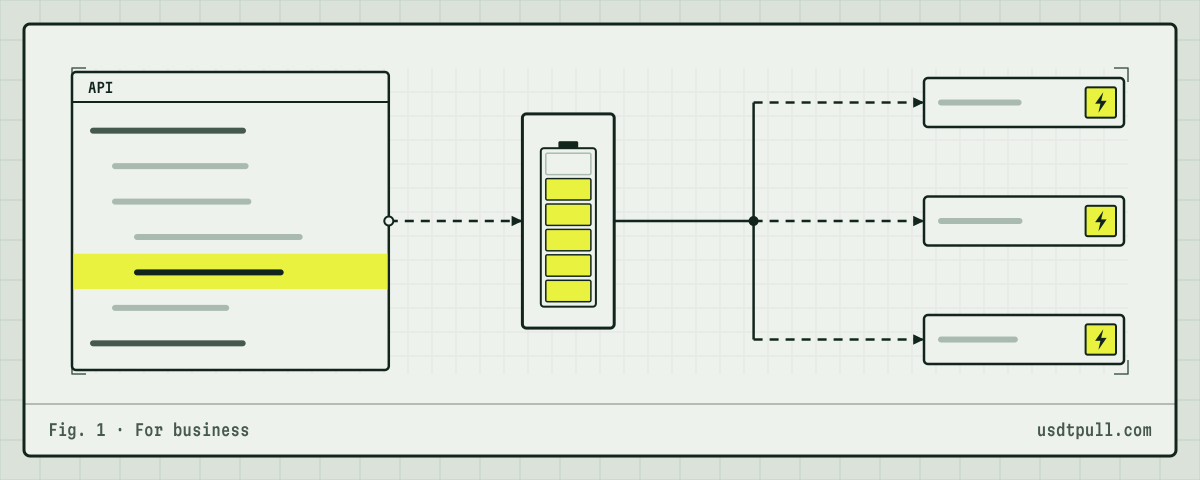
- Order after the deal is final and the address is checked, not at the quote. If the deal falls through, unused energy leaves at the end of the term, see how long rented energy lasts.
- Size the order for the transfers inside the term: 194,570 for a test plus main transfer to an empty address, 128,570 to a holder.
- Mind the gap after the test. If confirming it may take an hour, order energy for each transfer separately or choose the 1-day term; its price is shown in the service.
- On a peak day, order per wave of deals that will go out within the term.
- Leave room in the fee limit. If energy falls short, the network burns TRX only as far as the fee limit allows, otherwise the transfer fails with OUT_OF_ENERGY.
Before a large transfer: a checklist
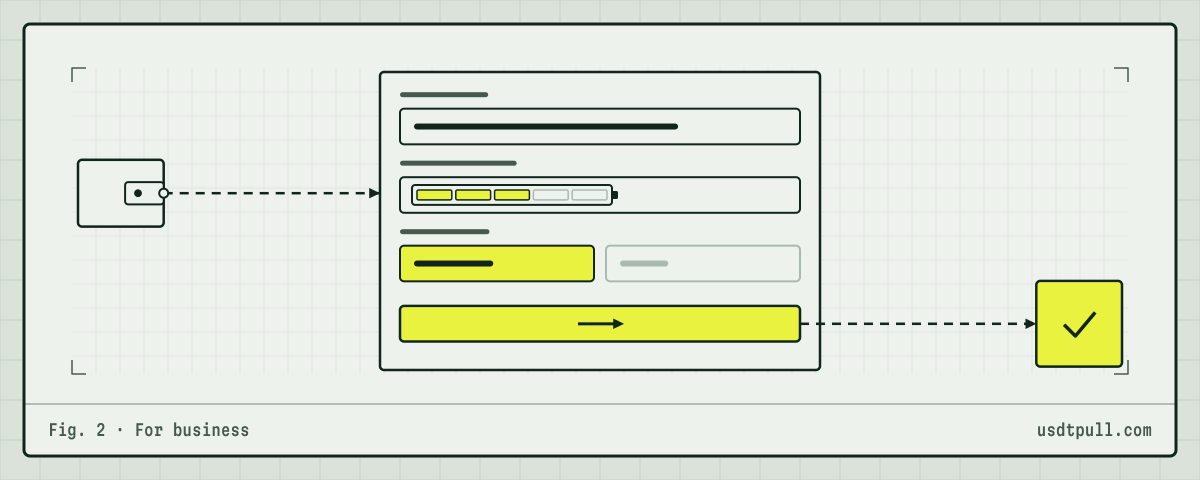
- Take the address from the agreed source or your whitelist and compare all 34 characters.
- Read the blacklist status of the counterparty’s address and your own. A listed address can receive USDT but not send it; the free check is in can Tether freeze USDT.
- Read the recipient’s USDT balance: above zero means 64,285, zero means 130,285.
- Send the test, then the main transfer with energy on the settlement address, and check the receipt: energy used, TRX burned, result SUCCESS.
UsdtPull offers a USDT freeze check and AML checks of addresses and transactions alongside energy, see the For business page. Rates and API keys are in the UsdtPull app.
FAQ
Does a larger USDT transfer cost more on TRON? No. On Nov 20, 2026 a 30,000,000 USDT transfer and a 1 USDT transfer each used 64,285 energy.
How much does a test transfer add? One standard transfer, 64,285 energy, as long as the counterparty keeps the test on the address.
Should an OTC desk stake TRX for energy? Only for the load it sends nearly every day. A stake sized for peaks sits mostly idle, and unstaking takes 14 days.
Why did a transfer to a regular counterparty use 130,285 energy? Its address held zero USDT at that moment. More answers are in the FAQ.