How to Accept USDT TRC-20 Payments: A Setup Guide for Businesses
Accepting USDT TRC-20 costs you nothing per incoming payment, but your address scheme decides what customers pay and what moving the money out costs.
- Category
- For business
- Published
- Reading time
- 8 min
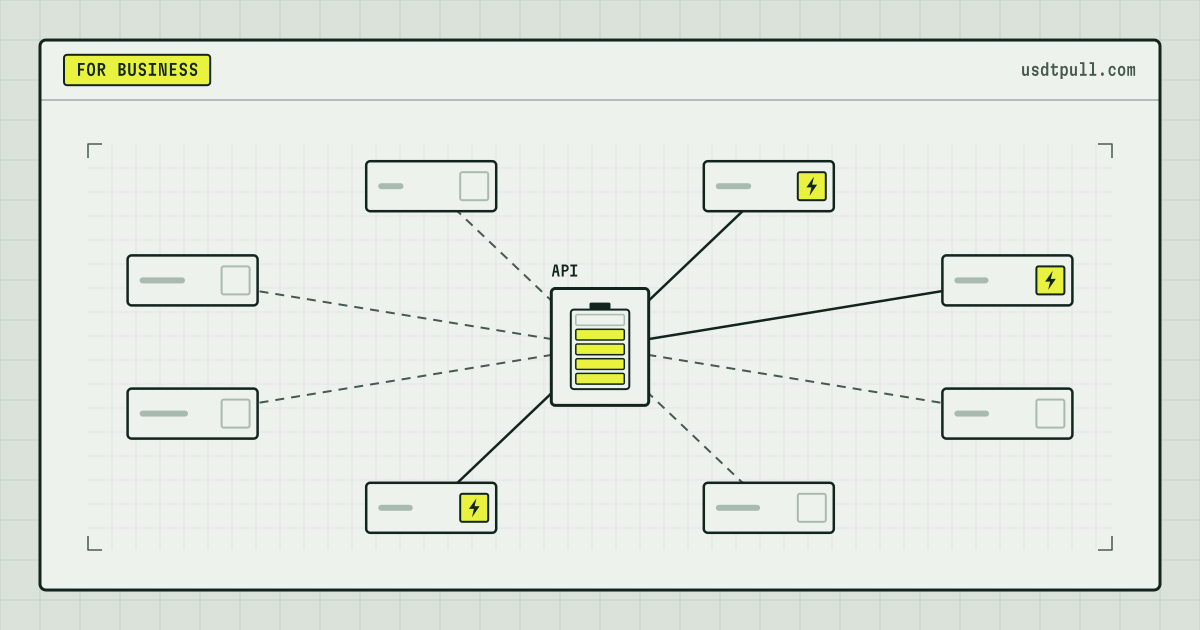
To accept USDT TRC-20 payments, a business needs a TRON address for customers to pay to, a rule for when a payment counts as received, and a plan for moving the money out. Receiving costs you nothing: the customer’s wallet pays the energy and bandwidth of the transfer. Your address scheme still sets two prices: what each customer pays to send, and what you pay later to sweep, refund and pay out.
Network figures below are as of Nov 20, 2026.
Who pays for what
A USDT TRC-20 payment is a call to the transfer function of the USDT contract TR7NHqjeKQxGTCi8q8ZY4pL8otSzgjLj6t, signed by the payer. The network charges the signer, so your address receives the full amount.
| Operation | Who pays | Energy, as of Nov 20, 2026 | Cost if energy is burned |
|---|---|---|---|
| Customer pays to an address that holds USDT | customer | 64,285 | 6.43 TRX |
| Customer pays to an address with zero USDT | customer | 130,285 | 13.03 TRX |
| You activate a new deposit address with TRX | you | none | 1.1 TRX fee |
| You sweep a deposit address to your main wallet | you | 64,285 | 6.43 TRX |
| You refund a customer | you | 64,285 or 130,285 | 6.43 or 13.03 TRX |
Energy burns at 100 SUN per unit. A transfer also uses about 345 bandwidth, covered for one transfer a day by the 600 free units every activated address gets. Why an empty recipient costs almost twice as much is explained in why sending to a new address costs more.
The second row matters most. “Zero USDT” does not mean only a brand-new address: an address swept to zero is priced the same way again.
Three ways to tell payments apart
A transfer call has two parameters, the recipient and the amount, and no reference field. TRON transactions can carry a note in raw_data.data, but java-tron charges the signer an extra fee for any transaction that has one, token transfers included (consumeMemoFee in Manager.java, added in PR #4758). As of Nov 20, 2026 that fee, getMemoFee, is 1 TRX, and not every payer’s wallet can add a note. So a business matches a payment by address, by amount, or both.
| Scheme | How a payment is matched | Customer’s energy | Your extra work |
|---|---|---|---|
| New address per invoice | by address | 130,285 every time | activate and sweep every address |
| Address per customer | by address | 130,285 if swept to zero, else 64,285 | activate once, sweep regularly |
| One shared address, tagged amounts | by amount, e.g. 120.000417 USDT | 64,285 | no sweeps, but matching by amount |
USDT has 6 decimals, so a 120 USDT invoice can be issued as 120.000417 USDT and told apart from other open invoices. The weak point is the payer: a customer who types 120 or splits the payment breaks the match, and the order goes to manual review. Address-based schemes do not depend on what the customer types.
One deposit address, read on chain
On Nov 20, 2026 we read the USDT history of a deposit address that received a payment in block 88,159,288. It is reused, and each sweep moves the full balance to the same collection wallet: in the ten deposits between Oct 23 and Nov 18, each sweep followed within about 1.4 to 12 minutes. Receipts from TronGrid gettransactioninfobyid:
| Time (UTC) | Transaction | Balance before | Energy used |
|---|---|---|---|
| Oct 14, 06:53:45 | 8.2 USDT in | 0 | 130,285 |
| Oct 14, 16:35:39 | 27.4 USDT in | 8.2 USDT | 64,285 |
| Oct 16, 07:30:18 | 35.6 USDT swept out | 35.6 USDT | 64,285 |
| Nov 18, 09:02:27 | 48 USDT in | 0 | 130,285 |
| Nov 18, 09:03:54 | 48 USDT swept out | 48 USDT | 64,285 |
| Nov 20, 05:19:09 | 49.0128 USDT in | 0 | 130,285 |
Same address, same sender, two prices. The one payment in the table priced at 64,285 arrived while 8.2 USDT was still on the address. Every payment after a full sweep cost the sender 66,000 more energy, 6.6 TRX if burned.
Model calculation: 3,000 payments a month
This is a model calculation, not data about a real business. Assumptions: 3,000 payments a month from 600 customers, five each; your collection wallet always holds USDT; one sweep per payment; no refunds. In scheme C the sweep leaves 1 unit (0.000001 USDT) on the address, so it never returns to zero.
| A: address per invoice | B: per customer, swept to zero | C: per customer, dust left | D: shared address | |
|---|---|---|---|---|
| Addresses to activate | 3,000 | 600 | 600 | 0 |
| Activation fees, TRX | 3,300 | 660 | 660 | 0 |
| Customer energy, total | 390,855,000 | 390,855,000 | 232,455,000 | 192,855,000 |
| Same, if customers burn TRX | 39,085.5 TRX | 39,085.5 TRX | 23,245.5 TRX | 19,285.5 TRX |
| Your sweeps | 3,000 | 3,000 | 3,000 | 0 |
| Sweep energy burned, TRX | 19,285.5 | 19,285.5 | 19,285.5 | 0 |
| Sweep energy rented, TRX | 6,630 | 6,630 | 6,630 | 0 |
In C, 600 first payments take 130,285 and 2,400 repeat payments 64,285. Your costs stay equal to B, while customers spend 158,400,000 less energy a month, 15,840 TRX at the burn price. A customer short of energy or TRX for the larger amount may see the payment fail.
The rental row uses the current rate on Nov 22, 2026: 34 SUN per unit of energy for 1 hour, 65,000 energy per sweep. The exact price is shown in the app before you pay, see pricing. A sweep threshold cuts the sweep rows further, as worked out in sweeping USDT from deposit addresses.
When to mark a payment as received
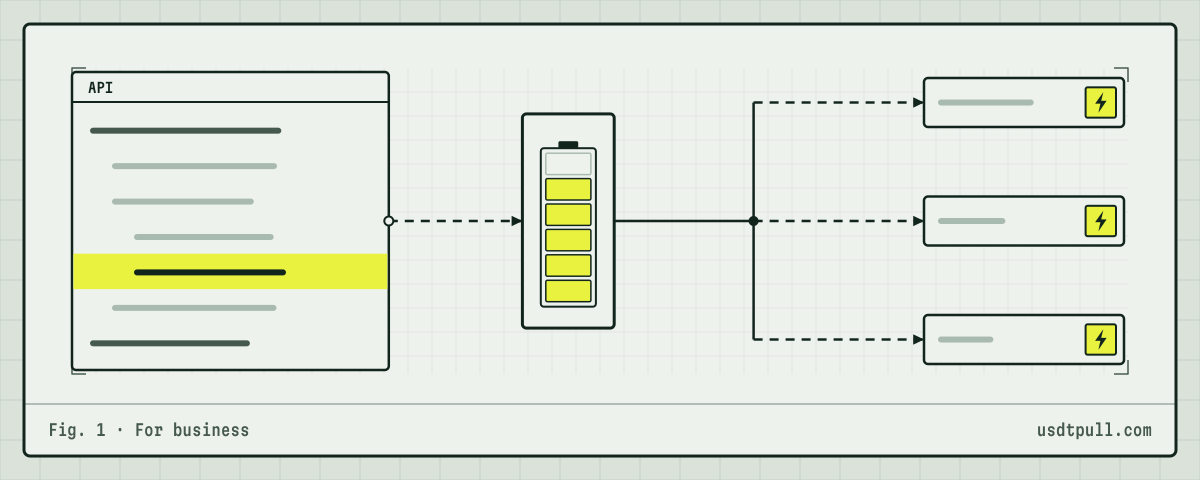
Credit an order only when all of these hold:
- The token is the real USDT, contract
TR7NHqjeKQxGTCi8q8ZY4pL8otSzgjLj6t. Look-alike tokens and zero-value transfers are a known trick, see address poisoning. - The result is SUCCESS and the recipient in the transfer event is your address.
- The amount matches the invoice under your tolerance rule.
- The block is irreversible, about a minute later; measurements are in how long a USDT TRC-20 transfer takes.
A sender on Tether’s blacklist cannot pay you at all, because the contract rejects the transfer, but your own deposit addresses can be listed too; how to read the status for free is in can Tether freeze USDT. A deposit address that has only received USDT is not activated and cannot sweep or take delegated energy until it receives TRX, see how to activate a TRON address.
Underpayments, overpayments and refunds
Set the rules in advance:
- Underpayment. Ask for the rest to the same address, or refund. On a per-customer address the second payment lands on a non-empty address and takes 64,285 energy, like the 27.4 USDT payment above.
- Overpayment. Hold the extra as a balance or refund it. Refunding 1 USDT takes the same energy as refunding 1,000 USDT.
- Refunds. Do not send a refund back to the address the payment came from: if the customer paid from an exchange, that address belongs to the exchange. Ask for a refund address. If the customer paid with their whole balance, their address now holds zero USDT and the refund needs 130,285 energy.
Setting it up, step by step
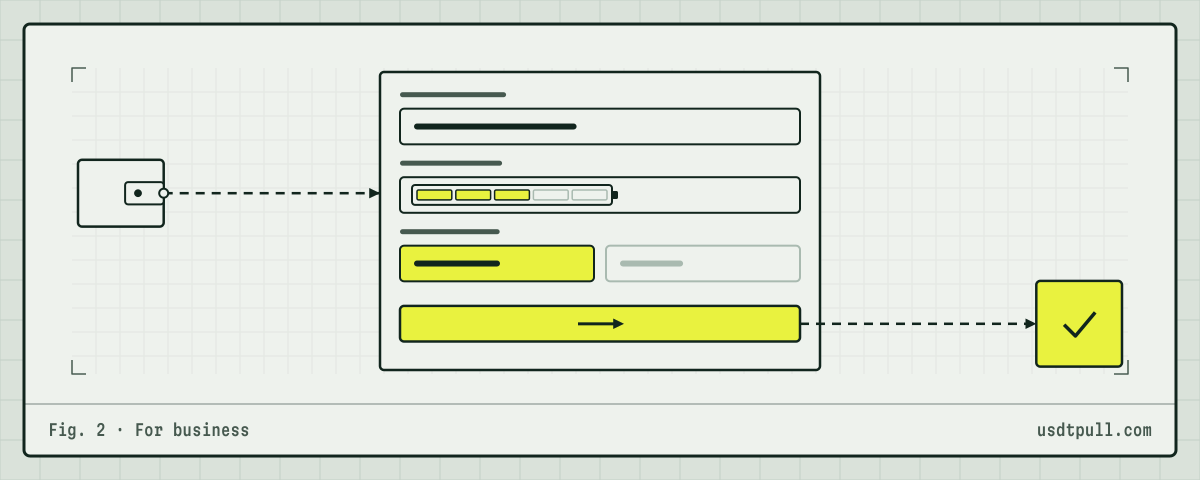
- Pick a scheme; per-customer addresses with dust left keep repeat payments cheap.
- Generate deposit addresses from keys you control and activate them with TRX before the first sweep.
- Decide how your system learns about incoming transfers and apply the four crediting checks.
- Choose the energy source for sweeps and refunds: burned TRX, your own stake (about 6,700 TRX staked per daily transfer as of Nov 20, 2026) or rented energy.
- Check your own addresses against the blacklist on a schedule.
UsdtPull also offers crypto acquiring and wallet tracking with transfer notifications; terms are on the pricing page and in the app, and the toolkit is on the For business page.
FAQ
Does it cost anything to receive USDT TRC-20? No. The sender pays the energy and bandwidth. Your costs start when you move the USDT.
Why did my customer pay a higher network fee than usual? Most likely your address held zero USDT at that moment: 130,285 energy instead of 64,285 as of Nov 20, 2026.
Can customers add a payment reference to a USDT transfer? The token transfer has no field for it. A transaction note costs the sender an extra 1 TRX, and not every wallet offers one.
How long should I wait before crediting a payment? About a minute, until the block is irreversible, and only if the contract, result, recipient and amount all match.