Sweeping USDT From Deposit Addresses: Energy Cost and Automation
What a USDT sweep from a deposit address costs on TRON, a real sweep cycle read on chain, and a burn, stake and rent model for 400 to 2,000 sweeps a day.
- Category
- For business
- Published
- Reading time
- 8 min
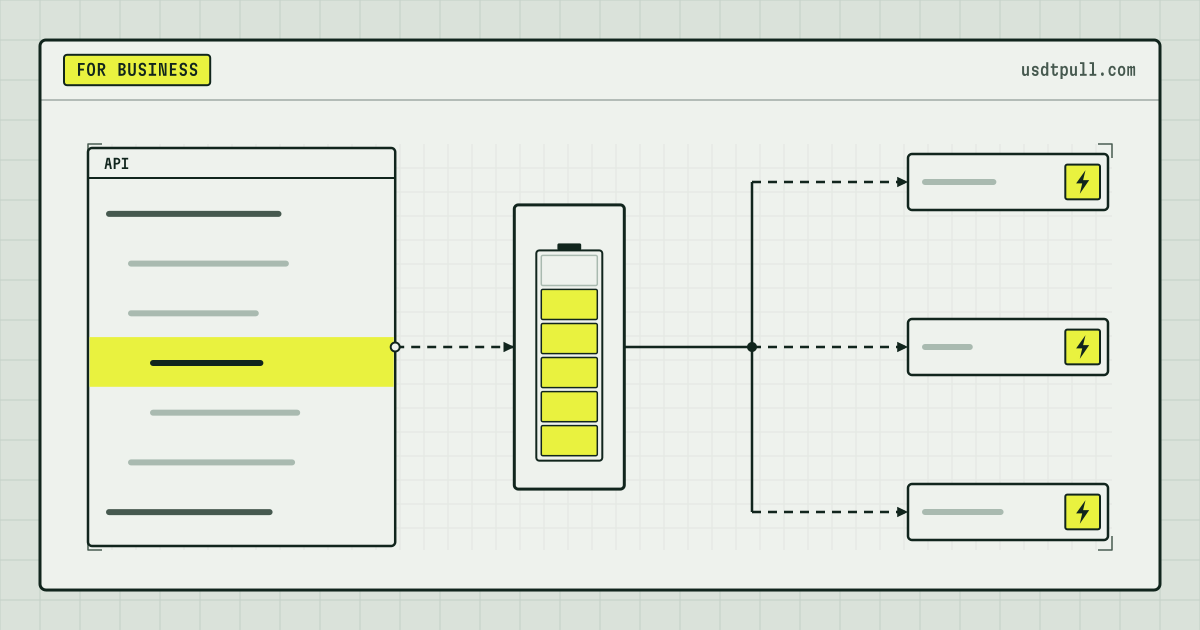
Sweeping USDT from a deposit address to your hot wallet is an ordinary TRC-20 transfer: 64,285 energy and about 345 bandwidth, whatever the amount, as long as the hot wallet already holds USDT. Without energy the network burns 6.4285 TRX for it. A sweep system has to solve activation, energy and bandwidth for every deposit address. Below: a real sweep cycle read on chain on Oct 19, 2026, and a model of 400 to 2,000 sweeps a day.
What one sweep uses
As of Oct 19, 2026: TronGrid chain parameters and block 87,237,974 with 75 USDT transfers.
| Item | Value | Why it matters for sweeps |
|---|---|---|
| Energy, recipient holds USDT | 64,285 | The normal case: the hot wallet holds a balance |
| Energy, recipient holds no USDT | 130,285 | Only if the hot wallet was emptied to zero |
| Bandwidth per transfer | about 345 | 71 of 75 transfers in the block |
| Energy burn price | 100 SUN per unit | getEnergyFee |
| Bandwidth burn price | 1,000 SUN per unit | getTransactionFee |
| Free bandwidth | 600 per address, rolling 24 hours | getFreeNetLimit, available only after activation |
Emptying the deposit address does not make the sweep cheaper; the hot wallet decides the price. Leave it at zero after a move to cold storage, and the next sweep needs 130,285 energy, as explained in why sending to a new address costs more.
A real sweep cycle, read on chain
One complete cycle from Oct 19, 2026, times in UTC. Judging by the pattern, TDD97yguPESTpcrJMqU6h2ozZbibv4Vaqm is an operator address and the other one a deposit address: the operator activates it, delegates energy from its stake, lets it sweep and takes the energy back.
| Time | Transaction | Who pays | What it cost |
|---|---|---|---|
| 03:59:36 | Deposit of 20.61 USDT arrives on the new address | the depositor | not the operator’s cost |
| 05:00:12 | 1 TRX sent to the address, which activates it | operator | 1.1 TRX fee, and the 1 TRX stays on the address |
| 05:01:21 | Energy delegated from 8,000 staked TRX, no lock | operator | 279 bandwidth, burned: 0.279 TRX |
| 05:15:42 | Sweep of 20.61 USDT to the hot wallet | deposit address | 64,285 energy from the delegation, 345 bandwidth from the free allowance, 0 TRX |
| 05:16:42 | Delegation taken back | operator | 281 bandwidth, burned: 0.281 TRX |
What the cycle shows:
- Activation came first. An address that has only received USDT is not an account yet: it cannot send, and the network refuses to delegate energy to it. See how to activate a TRON address.
- Delegation from stake costs bandwidth. The two delegation transactions burned 0.56 TRX. At 9.59 energy per staked TRX (Oct 19), the 8,000 TRX gave about 76,700 energy.
- The used energy goes back to the stake. In java-tron, taking a delegation back moves the receiver’s used energy to the owner, where it recovers over 24 hours. A stake covers only as many sweeps a day as its daily energy allows.
- The free allowance paid for the sweep’s bandwidth. One sweep a day fits into 600 free units. Right after it only about 255 units are left, and used bandwidth recovers gradually over 24 hours, so a second sweep from the same address within roughly 6 hours would burn 0.345 TRX, because bandwidth is taken from one source in full.
- Dust arrives fast. Within about a minute of the sweep, strangers sent the address two unknown TRC-10 tokens and two 1 SUN TRX transfers. Credit only transfers of the real USDT contract,
TR7NHqjeKQxGTCi8q8ZY4pL8otSzgjLj6t; how to check one is in how to track a USDT TRC-20 transaction.
Three ways to pay for a sweep
| Energy source | Energy cost per sweep | Extra transactions | What it locks |
|---|---|---|---|
| Burn TRX | 6.4285 TRX | none | nothing, but the deposit address needs 6.43 TRX on it |
| Stake TRX and delegate | 0 | delegate and take back: about 564 bandwidth, or about 0.56 TRX if burned | about 6,703 TRX per sweep a day |
| Rent 65,000 energy at 30 SUN | 1.95 TRX | none on your side; the energy returns by itself | nothing |
The rental line uses the current rate on Nov 15, 2026, 30 SUN per unit of energy for 1 hour. The rate changes, and the exact price is shown in the app before you pay, see the pricing page.
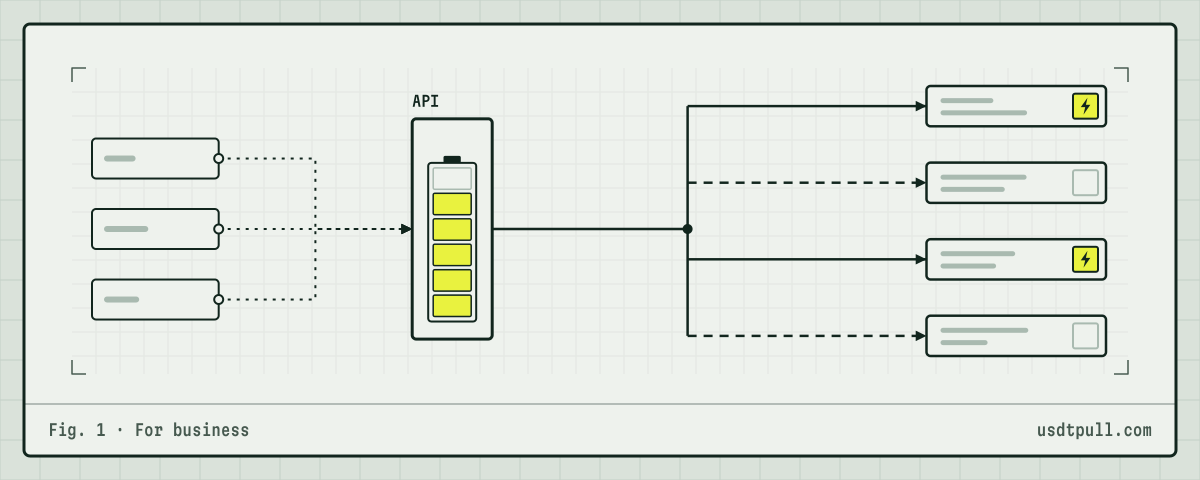
Burning also means sending 6.43 TRX to every deposit address first. With staking or rental, energy lands on the address directly.
Model calculation: 2,000 deposits a day
This is a model calculation. The business is hypothetical:
- 2,000 USDT deposits a day, 100 USDT on average, on 1,200 different deposit addresses;
- the hot wallet always holds USDT, so every sweep uses 64,285 energy;
- all addresses are already activated.
Three sweep policies:
- Every deposit: 2,000 sweeps a day.
- Once a day per address: 1,200 sweeps.
- At a 500 USDT threshold: roughly one sweep per five deposits, so about 400. The real figure depends on your deposit sizes.
| Policy | Sweeps a day | Energy a day | Burn, TRX a day | Rental at 30 SUN, TRX a day | TRX staked to cover it |
|---|---|---|---|---|---|
| Every deposit | 2,000 | 128,570,000 | 12,857.0 | 3,900 | about 13.4 million |
| Once a day per address | 1,200 | 77,142,000 | 7,714.2 | 2,340 | about 8.0 million |
| 500 USDT threshold | 400 | 25,714,000 | 2,571.4 | 780 | about 2.7 million |
Two costs sit outside the table:
- Bandwidth on deposit addresses. In policy 1, 800 sweeps a day are repeat sweeps from an address that already swept that day. If a repeat comes within about 6 hours of the previous sweep, it burns 0.345 TRX: up to 276 TRX a day. Policies 2 and 3 stay mostly within the free allowance.
- Delegation transactions, if you stake. Two per sweep, about 564 bandwidth together: up to 1,128 TRX a day for policy 1 and 225.6 TRX for policy 3 if your staking address has no bandwidth of its own.
How the threshold works
A sweep costs the same for 20 USDT and for 20,000 USDT, so the useful number is the cost per amount collected. Per 1,000 USDT swept, with 100 USDT deposits:
| Threshold | Sweeps per 1,000 USDT | Burn, TRX | Rental at 30 SUN, TRX |
|---|---|---|---|
| Sweep every deposit | 10 | 64.29 | 19.5 |
| 500 USDT | 2 | 12.86 | 3.9 |
| 1,000 USDT | 1 | 6.43 | 1.95 |
The price of a threshold: funds wait longer, the hot wallet has less for payouts, and some balances never reach it. So add a time rule: sweep at the threshold or after a set number of days. The idea is introduced in USDT transfer costs for exchanges; the table puts numbers on it.
Automating the sweep
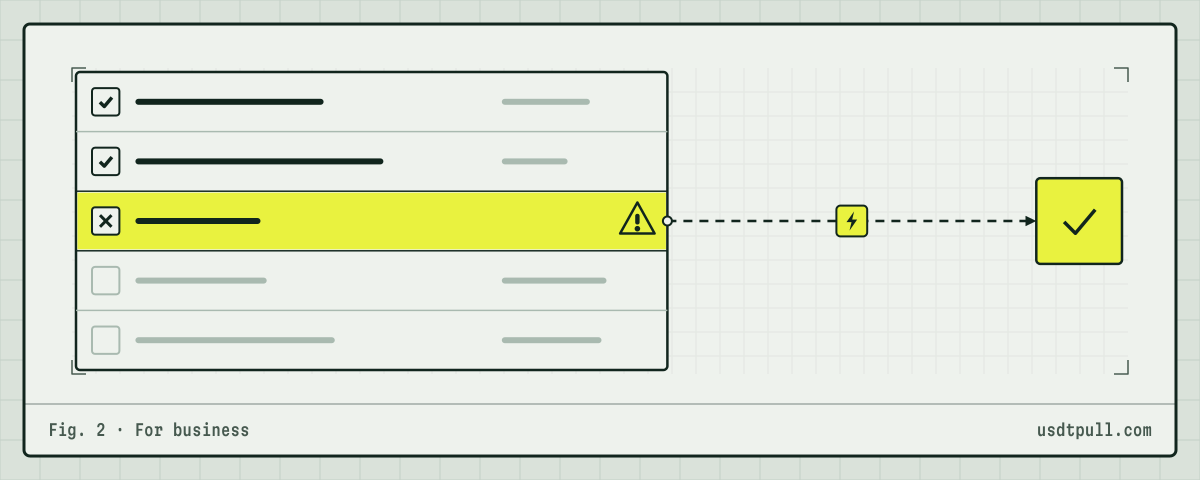
These are the mechanics we could verify on chain and in the TRON code, in order:
- Pick the addresses to sweep by your threshold rule, counting only transfers of the real USDT contract.
- Check that each address exists on chain. For an address that has never received TRX, the
getaccountcall on TronGrid returns an empty object. Send it TRX first: the sender pays 1.1 TRX in fees. - Check the hot wallet balance. If it is zero, plan 130,285 energy for the first sweep.
- Put energy on the deposit address. Delegate from your own stake (
DelegateResourceContract, lock optional), or order energy through the UsdtPull API with the deposit address as the receiver and wait for delegation. Methods and request budget are in the TRON energy rental API guide. Rented energy stays for 1 hour, so sweep inside it. - Sign the sweep with the deposit address key, sending the full USDT balance to the hot wallet.
- Take back your own delegation if you used stake. Rented energy returns on its own when the hour ends.
- Reconcile the receipt.
energy_feeandnet_feeshould both be 0. Anything else means a step was skipped.
Energy belongs to the address that receives it, so it is one order per deposit address per sweep. An address that sends all the time, such as the payout hot wallet, needs its own energy plan, covered in batch USDT payouts. The business toolkit is described on the For business page.
FAQ
Does a deposit address need TRX to sweep? It needs to be activated by an incoming TRX transfer. With delegated energy and one sweep a day inside the free 600 bandwidth, the sweep itself burns nothing.
Does a full-balance sweep cost less? No. The sweep we read on chain emptied the address and still used 64,285 energy.