TRON Energy for dApps and Bots: Who Pays for Users' USDT Calls
How TRON splits energy between a contract's deployer and its caller, real contract settings as of Nov 20, 2026, and a month of energy for a USDT bot.
- Category
- For business
- Published
- Reading time
- 8 min
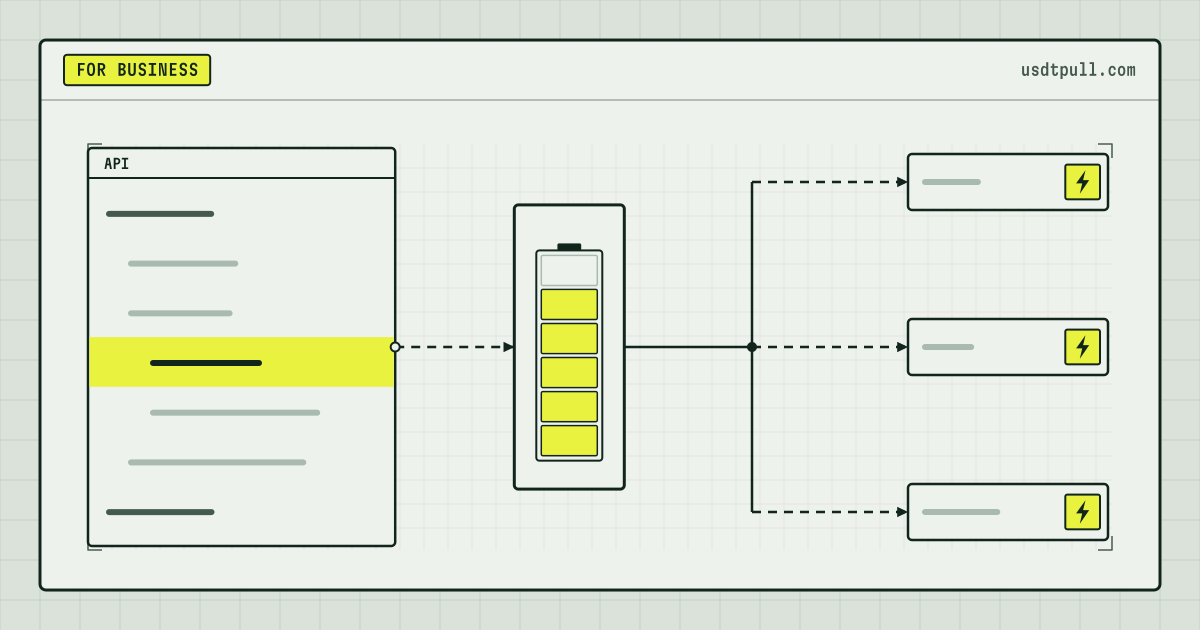
On TRON, the address that signs a contract call pays its energy, unless the contract’s deployer has agreed to cover a share. That share is set per contract by consume_user_resource_percent and origin_energy_limit, and it works only while the deployer’s address holds energy. A Telegram bot or dApp that moves USDT cannot use it, because USDT is Tether’s contract: the operator either pays from its own addresses (custodial model) or delegates energy to each user’s address (non-custodial model).
Below: the split formula from the java-tron code, real contract settings and transactions from Nov 20, 2026, and a model calculation for a withdrawal bot.
How TRON splits energy between deployer and caller
Every contract stores two settings, readable for free with wallet/getcontract:
| Field | Range | Meaning |
|---|---|---|
consume_user_resource_percent |
0 to 100 | The caller’s share of the call’s energy, in percent |
origin_energy_limit |
above 0 | The most energy the deployer pays for one transaction |
The network computes the deployer’s part in payEnergyBill (ReceiptCapsule.java):
deployer pays = min(total energy × (100 - percent) / 100, deployer’s available energy, origin_energy_limit)
caller pays = total energy - deployer pays
The caller covers its part from its own energy first, then burns TRX, within its fee_limit. Per the code and the TRON guide on paying for resources:
- The split belongs to the contract the transaction calls directly. java-tron reads the settings of the contract named in
TriggerSmartContract; internal calls, such as token transfers inside a swap, are paid under that split. - The deployer’s energy can be staked or delegated.
- Only energy is shared. The caller always pays its own bandwidth. A deployer calling its own contract pays everything.
Only the deployer can change the settings: wallet/updatesetting for the percent, wallet/updateenergylimit for the limit.
The settings on real contracts, Nov 20, 2026
Settings from TronGrid and labels from the TronScan API, read on Nov 20, 2026 around 05:30 UTC:
| Contract (TronScan label) | Caller pays | origin_energy_limit |
Deployer’s daily energy |
|---|---|---|---|
| USDT | 30% | 10,000,000 | 9,335 |
| SunSwap UniversalRouter | 1% | 1,000,000 | about 2.0 billion |
| SunSwap UniversalRouter (deprecated) | 100% | 1,000,000 | same deployer |
| SunSwap Smart Exchange Router (deprecated) | 100% | 1,000,000 | same deployer |
| SunSwap V2 Router (deprecated) | 100% | 100,000 | 0 |
The percent alone means little: USDT asks callers for 30%, but its deployer has almost no energy, so callers pay nearly everything. And settings change over time: the SunSwap routers TronScan marks as deprecated leave all energy to users, while the UniversalRouter it labels without that mark, deployed on May 8, 2026 from the same address as two of the deprecated ones, asks users for 1%.
A swap where the deployer paid 99%
This swap through that 1% UniversalRouter landed in block 88,159,434 at 05:26:27 UTC. Its receipt:
energy_usage_total199,080, the whole call with its 18 internal transactions;origin_energy_usage197,089, paid by the router’s deployer;energy_usage1,991, from the caller’s own energy;net_usage1,918 bandwidth, paid by the caller; no TRX burned.
The formula matches to the unit: 199,080 × 99 / 100 = 197,089.2, rounded down. Burned at 100 SUN, the deployer’s part would be 19.71 TRX. In the same block, a contract set to 97% for callers took 960 of 32,033 units from its deployer, again 3% rounded down (transaction).
A USDT transfer where the deployer paid 1 unit
This USDT transfer in block 88,159,288 used 64,285 energy. By the percent, Tether’s deployer THPvaU…hFhn5YC owed 70%, or 44,999 units. It had 1 unit available, so origin_energy_usage is 1, and the sender burned 6,428,400 SUN (6.4284 TRX) for the other 64,284.
Why this does not cover a USDT bot
A bot that sends USDT calls Tether’s contract directly. Energy the operator stakes on its own addresses is not used unless the operator’s address is the sender.
The workaround suits a dApp more than a bot: deploy your own contract with a low caller share, keep energy on the deployer’s address, and let users call it, moving USDT inside the call, as the swap above does. Two costs come with it. Each user first calls approve on USDT itself, under USDT’s split, and pays for that. And the deployer pays for every call until its daily energy runs out; after that, calls fall back on users.
For a plain withdrawal or payment bot, the energy has to be on the sending address.
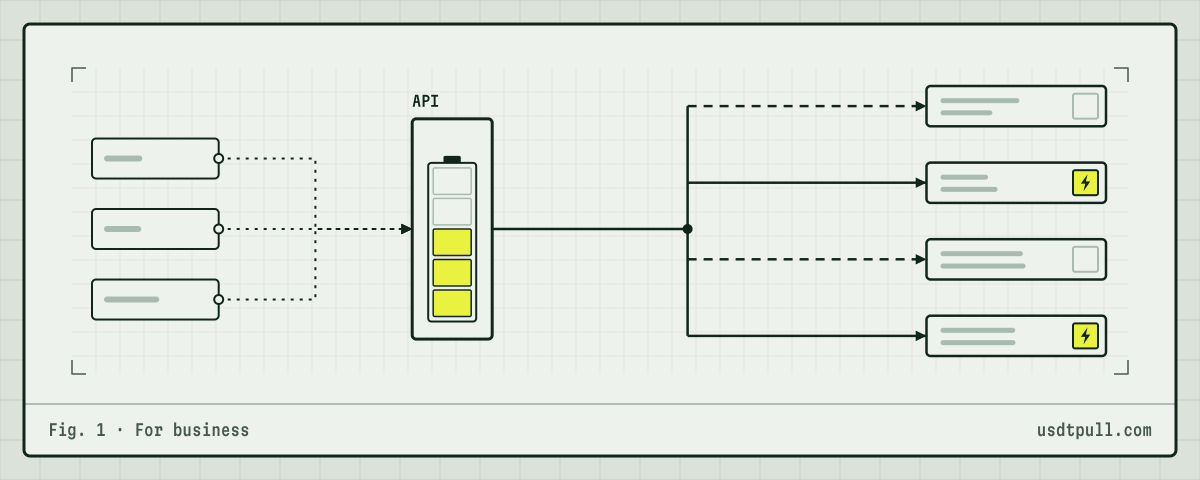
Custodial and non-custodial bots
| Custodial bot | Non-custodial bot | |
|---|---|---|
| Who holds the keys | The operator | The user |
| Who signs the transfer | The operator’s hot wallet | The user’s wallet |
| Where energy must be | A few operator addresses | Each user’s address, before each transfer |
| How the operator pays | Stake, rent or always-on energy | Delegate or rent energy to the user |
| Extra work | Sweeping deposit addresses | Receiver activated; transfer within the term |
A custodial bot pays energy like any payout desk: one order can cover a batch, as in batch payout planning, and deposits to per-user addresses add sweep transfers.
A non-custodial bot can only move energy to the user. Delegation needs no signature from the receiver, but the receiver must exist on chain and cannot be a contract (how delegation works). Once energy arrives, the user can spend it on any call; a per-user limit in the bot is the only control.
Model calculation: one month of a withdrawal bot
Assumptions: 100 USDT withdrawals a day for 30 days, 3,000 transfers; 20% go to addresses with no USDT. Site round figures: 65,000 energy per standard transfer, 131,000 per transfer to such an address.
Energy a month = 2,400 × 65,000 + 600 × 131,000 = 234,600,000
| Way to pay (custodial bot) | Cost a month |
|---|---|
| Burn TRX at 100 SUN per unit | 23,460 TRX |
| Rent energy at 34 SUN for 1 hour | 7,976.4 TRX |
| Kept by renting instead of burning | 15,483.6 TRX |
| Stake TRX for energy | about 803,000 TRX locked |
The stake line uses exact figures (64,285 and 130,285): 7,748,500 energy a day at 9.65 energy per staked TRX as of Nov 20, 2026. Bandwidth comes on top: 345 units a transfer, up to 1,035 TRX a month if all of it is burned.
A non-custodial bot needs the same energy in 3,000 separate deliveries. The trap is order size: always ordering 131,000 to be safe means 393,000,000 units instead of 234,600,000, and the extra 158,400,000 cost 5,385.6 TRX. A free balanceOf call shows whether the recipient already holds USDT; triggerconstantcontract gives the exact estimate.
The rate on Nov 22, 2026 is a reference: the exact price is shown in the service before you pay, and current figures are on the pricing page.
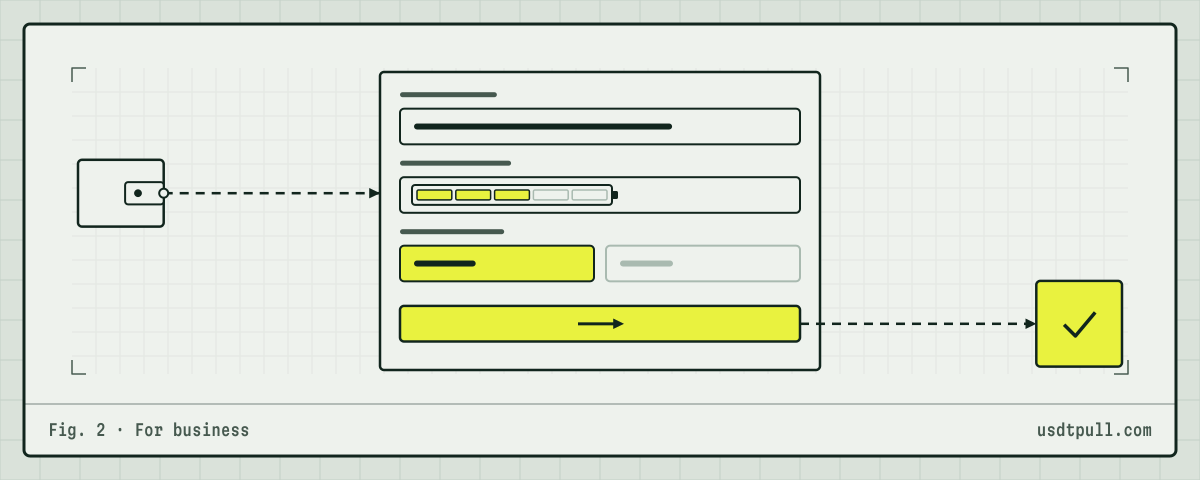
What to do, step by step
- Read the settings of every contract your users call with
wallet/getcontract, and the deployer’s energy withwallet/getaccountresource. - If you deploy your own contract, set
consume_user_resource_percentexplicitly: the TRON guide notes that TronWeb fills in 100 when it is omitted. Keep energy on the deployer’s address for your daily volume. - For a custodial bot, keep energy on the hot wallet: per batch through the energy API, or always-on energy, topped up after every transaction.
- For a non-custodial bot, deliver energy right before the user signs: an API order names the receiving address (
toAddressin the API documentation). Size it by the recipient and cap orders per user. - Reconcile receipts:
energy_usage,origin_energy_usageandenergy_feeshow who paid each unit. More tools are on the For business page.
FAQ
Can consume_user_resource_percent make USDT transfers free for my users? No. The split belongs to the contract being called, and for a transfer that is Tether’s contract.
Does a setting of 0 mean users pay nothing?
Not always. The deployer pays only up to its available energy and origin_energy_limit; the caller pays the rest and always pays bandwidth.
Can rented energy pay a deployer’s share? Yes. Delegated energy on the deployer’s address counts, and renting is delegation. Delegation goes to the deployer’s account, not to the contract, which cannot receive energy.
Why do USDT receipts sometimes show origin_energy_usage of 1? Tether’s deployer has about 9,335 energy a day, recovering at roughly 1 unit every 9 seconds, so a transfer sometimes catches one recovered unit. More answers are in the FAQ.