Planning TRON Energy for Batch USDT Payouts: A Worked Example
A model calculation for USDT TRC-20 mass payouts: energy per batch, bandwidth, a safety margin and what the 1-hour rental term means for your schedule.
- Category
- For business
- Published
- Reading time
- 8 min
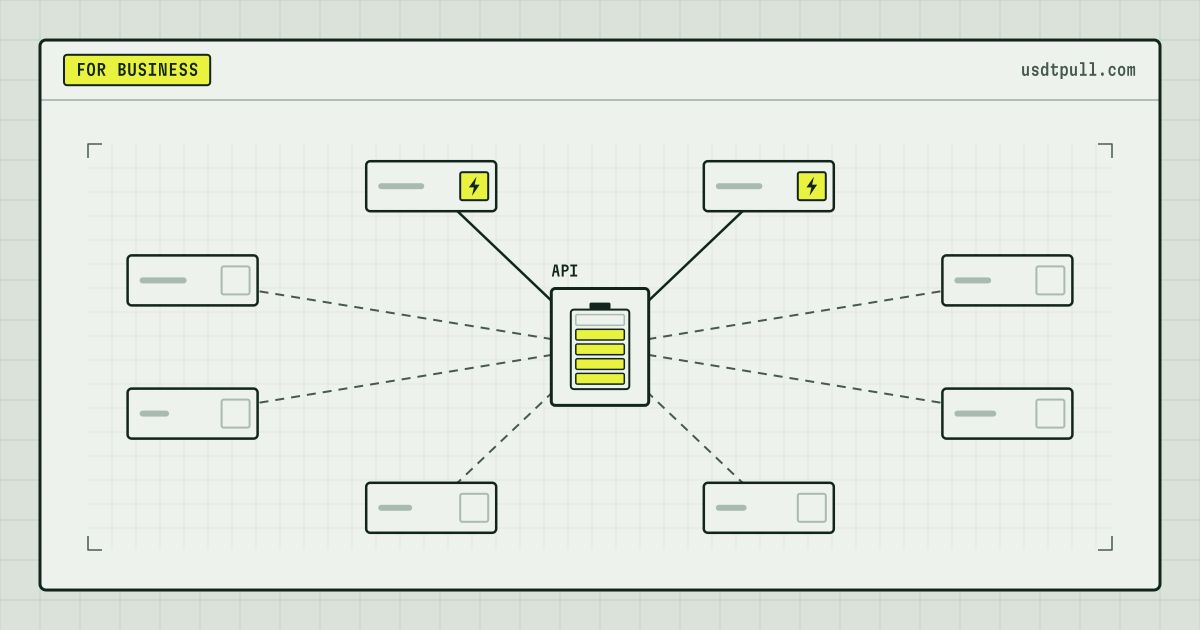
To plan energy for a batch of USDT TRC-20 payouts, count the recipients by type: each one that already holds USDT needs 64,285 energy, each one without USDT needs 130,285 (measured on chain on Oct 13, 2026). Add about 345 bandwidth per transfer and a small margin, then make sure the whole batch goes out while the rented energy is on your address. Below is a model calculation for a payout service that sends 600 payouts a day in four batches.
The numbers a payout plan rests on
All figures are as of Oct 13, 2026. Network parameters come from TronScan chain parameters, transfer figures from our own sample of block 87067211, which held 82 USDT transfers.
| Input | Value | Where it comes from |
|---|---|---|
| Energy, recipient holds USDT | 64,285 | 68 of 82 transfers in the block |
| Energy, recipient has no USDT | 130,285 | 14 of 82 transfers in the block |
| Bandwidth per USDT transfer | about 345 | most transfers in the block |
| Burn price of energy | 100 SUN per unit | chain parameter getEnergyFee |
| Burn price of bandwidth | 1,000 SUN per unit | chain parameter getTransactionFee |
| Free bandwidth per address | 600 a day | chain parameter getFreeNetLimit |
The site usually rounds the energy figures to 65,000 and 131,000. For a batch of hundreds of transfers, the exact values are worth using: the gap adds up.
The USDT contract’s dynamic energy factor stood at 34,000 on Oct 13, 2026, which is the network maximum (getDynamicEnergyMaxFactor). In plain terms, a USDT transfer already costs as much energy as the dynamic model allows under current parameters. A proposal that changes the parameters would change that, so recheck the numbers when one passes.
The model: 600 payouts a day in four batches
This is a model calculation. The business and its numbers are assumptions chosen for the example, not data from a real client:
- 600 payouts a day, sent in four batches of 150, every six hours;
- all payouts go from one payout address;
- 20% of recipients have no USDT on their address. Take this share from your own payout history. For reference only: in the single block we sampled, 14 of 82 USDT transfers (about 17%) went to addresses without USDT. One block is a snapshot, not a benchmark.
Energy per batch
Energy per batch = standard transfers × 64,285 + transfers to new addresses × 130,285.
- 120 × 64,285 = 7,714,200
- 30 × 130,285 = 3,908,550
- total: 11,622,750 energy per batch
A safety margin
The recipient check happens before the batch, and the state of an address can change before the transfer reaches it: a customer may withdraw everything and leave a zero balance. Each such surprise costs 66,000 extra energy. In the model we add room for two of them: 2 × 66,000 = 132,000, so the order is 11,754,750 energy.
Is the margin worth it? At an example rate of 32 SUN per unit for 1 hour, 132,000 energy costs 4.22 TRX. A single shortfall of 66,000 energy, if the network burns TRX for it, costs 6.6 TRX. The 32 SUN rate is an example rate: the exact price is shown in the app before you pay, see pricing.
Bandwidth per batch
150 × 345 = 51,750 bandwidth. The free allowance of 600 covers one transfer at most: bandwidth is taken from a single source in full, so the second transfer of the batch no longer fits into what is left, and six hours later the allowance has not recovered enough for a whole transfer either. If the address has no bandwidth of its own, the network burns 1,000 SUN per unit, so up to 51.75 TRX per batch. Keep that much TRX on the payout address, or more, before every batch.
Batch, day and month in one table
| Period | Energy used | Energy burned, TRX | Energy rented at 32 SUN (example), TRX | Bandwidth burned (up to), TRX |
|---|---|---|---|---|
| 1 batch | 11,622,750 | 1,162.28 | 376.15 (incl. margin) | 51.75 |
| 1 day, 4 batches | 46,491,000 | 4,649.10 | 1,504.61 | 207.00 |
| 30 days | 1,394,730,000 | 139,473.00 | 45,138.24 | 6,210.00 |
Two things stand out. First, bandwidth is not a rounding error at this volume: 207 TRX a day is about 14% of the rental cost in the example. Second, the margin adds only about 1% to the order: 132,000 on top of 11,622,750.
For comparison, staking (freezing) TRX instead: on Oct 13, 2026 one staked TRX gave about 9.61 energy and 1.62 bandwidth a day. Covering this model with staking would take about 4.84 million TRX for energy and about 128,000 TRX for bandwidth. That ratio changes daily with the total amount staked across the network.
How the share of new addresses moves the cost
The same batch of 150 payouts, with a different share of recipients that hold no USDT:
| Recipients without USDT | Energy per batch | Burned, TRX | Rented at 32 SUN (example), TRX |
|---|---|---|---|
| 0% | 9,642,750 | 964.28 | 308.57 |
| 10% | 10,632,750 | 1,063.28 | 340.25 |
| 20% | 11,622,750 | 1,162.28 | 371.93 |
| 40% | 13,602,750 | 1,360.28 | 435.29 |
Every 10 percentage points add 990,000 energy per batch of 150. If your new-address share grows, for example during a campaign that brings in new customers, the energy plan has to follow.
What the 1-hour term means for your schedule
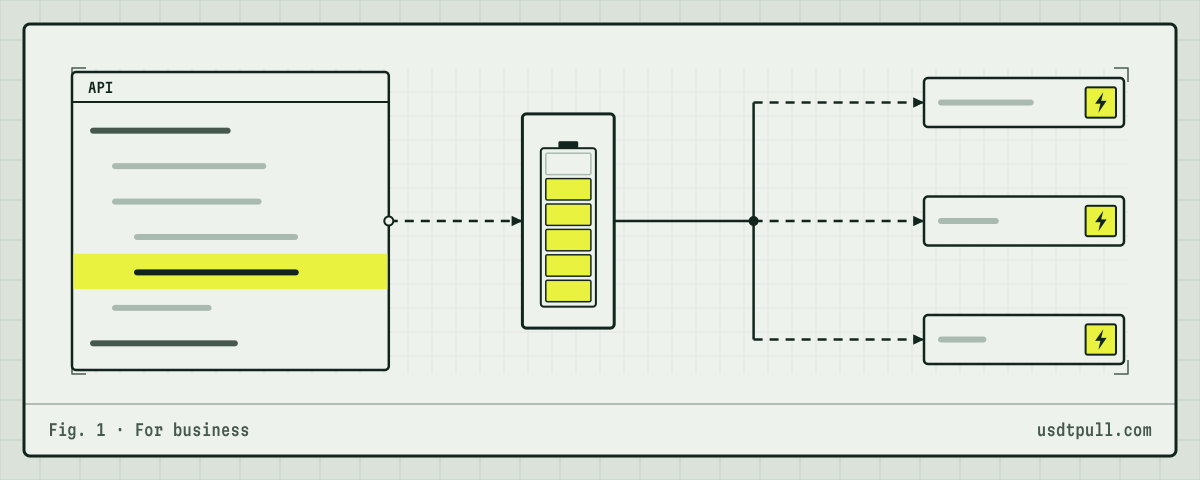
In the UsdtPull API documentation, the rental duration has one value: Hour1. When the hour ends, the energy returns automatically, used or not. For batch payouts that sets three rules:
- One order per batch, sized for that batch. Energy left over from the morning batch will not be there in the afternoon.
- Send the batch inside the hour. 150 transfers in an hour is 2.5 a minute, which a payout script handles easily. If your batch is larger or slower, split it into several orders.
- Order per address. Energy sits on the address that receives the delegation. If payouts go from three hot wallets, each needs its own order, sized for its own part of the batch.
The batch routine, step by step
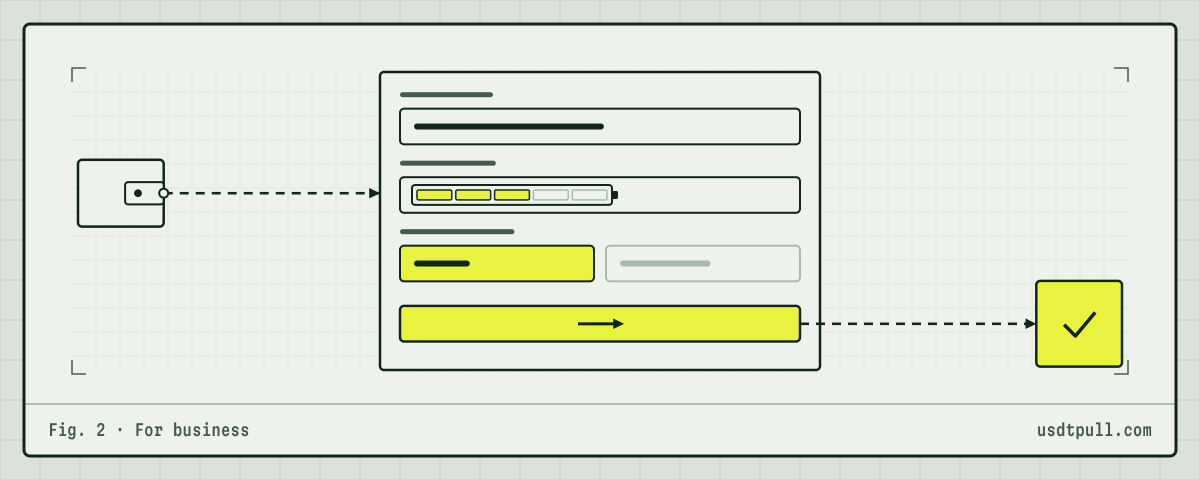
- Freeze the list. Collect the payouts for the batch and stop adding new ones.
- Check every recipient for a USDT balance and split them into standard and new.
- Calculate the order with the formula above plus a margin, and check the price and allowed volume through the quote method of the API. Methods and request signing are covered in the TRON energy rental API guide.
- Check TRX for bandwidth on the payout address.
- Place the order and wait for delegation, then start sending.
- Reconcile afterwards. Sum the energy used and any TRX burned from the transaction receipts in TronScan. Burned TRX on a transfer means the plan missed something: a recipient type, the margin or the hour.
If batches are frequent, always-on energy on the payout address can replace per-batch orders: it is topped up automatically after each transaction. A wider view of payout costs for exchanges is in USDT transfer costs for exchanges, and the business toolkit is described on the For business page. The current rate and API keys are in the UsdtPull app.
FAQ
Can I order energy for the whole day at once? Not with a 1-hour term. Size one order per batch, or use always-on energy for a continuous flow.
Why use 64,285 and not 65,000? 65,000 is a rounded figure. For one transfer it does not matter, but for 120 standard transfers the rounding adds 85,800 energy you do not need.
What happens if energy runs out mid-batch? The network burns TRX for the shortfall, as long as the fee limit allows it. If the fee limit is too low, the transfer fails with OUT_OF_ENERGY.
Does the payout amount change the energy? No. A 5 USDT payout and a 5,000 USDT payout use the same energy, so small payouts carry the highest cost share. Why new recipients cost more is explained in this breakdown.