USDT TRC-20 Transaction Failed? Every Status Code and What It Costs
REVERT, OUT_OF_ENERGY, OUT_OF_TIME and 13 more TRON result codes: what each means, what it burns and what to do, checked on 568 USDT calls on Nov 20, 2026.
- Category
- Transfer errors
- Published
- Reading time
- 8 min
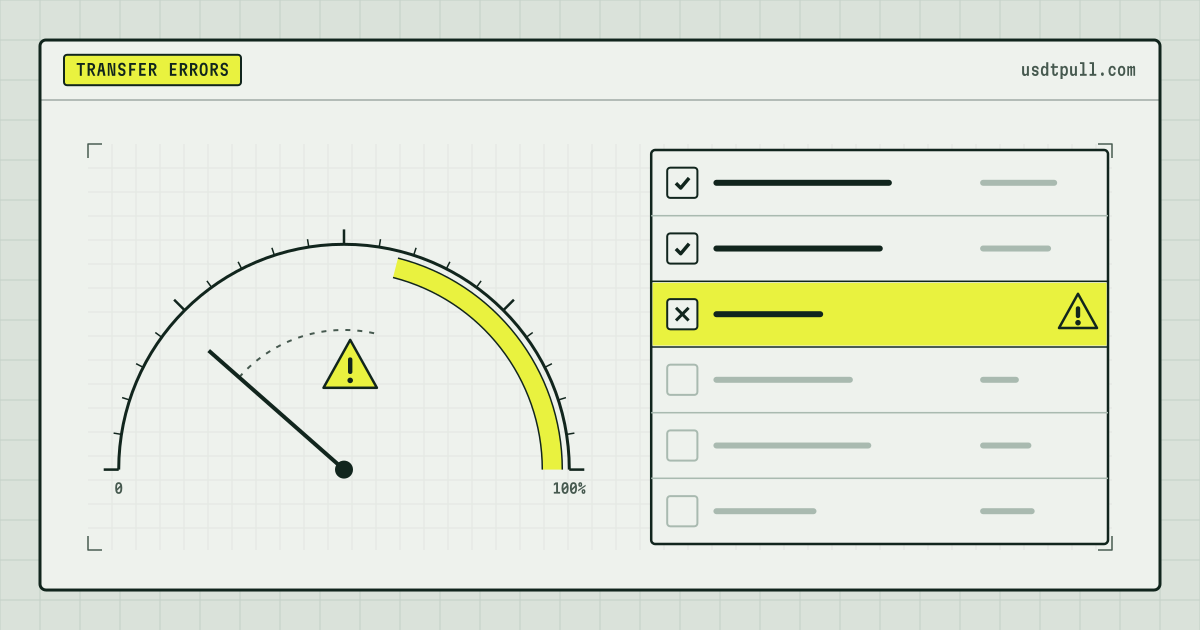
A failed USDT TRC-20 transaction made it into a block, but the USDT contract stopped before the transfer finished. No USDT moves, yet the network keeps what the attempt consumed, and the result code decides how much: REVERT pays only for the energy used up to the stop, while OUT_OF_TIME and most other exceptions use up the whole energy budget the sender allowed. A transaction that never reached a block costs nothing.
Below: all 16 codes, their charges and real USDT failures as of Nov 20, 2026.
Where TRON records the result
Each contract call ends with a value from the contractResult list in Tron.proto. It appears as ret[0].contractRet in the transaction (wallet/gettransactionbyid) and as receipt.result in the transaction info (wallet/gettransactioninfobyid); java-tron checks that the two match when it processes a block. The transaction info also has a top-level result that holds only FAILED and is left out on success. Zero values are omitted as well: a receipt without energy_fee burned nothing for energy.
Finding a transaction by hash is covered in tracking a USDT transaction on TronScan.
All 16 result codes: meaning, charge, next step
Meanings follow the smart contract errors guide and the error table. Charges come from java-tron: RuntimeImpl.java assigns the code, VMActuator.java decides how much energy is spent. Bandwidth is charged for every call that lands in a block, failed or not.
| Status (number) | What it means | What is charged | What to do |
|---|---|---|---|
| SUCCESS (1) | The call finished | Energy used: 64,285 or 130,285 for USDT on Nov 20, 2026 | Nothing |
| REVERT (2) | The contract refused: a failed require or explicit revert |
Only the energy used up to the stop | Check the USDT balance, the amount and the blacklist status |
| OUT_OF_ENERGY (10) | The energy budget ran out mid-run | The whole budget | Add energy or TRX, see below |
| OUT_OF_TIME (11) | CPU time limit exceeded, or a protocol check failed | The whole budget | Read the message; keep the fee limit sensible |
| BAD_JUMP_DESTINATION (3), ILLEGAL_OPERATION (8), STACK_TOO_SMALL (6), STACK_TOO_LARGE (7), OUT_OF_MEMORY (4), JVM_STACK_OVER_FLOW (12), PRECOMPILED_CONTRACT (5), UNKNOWN (13) | The contract code hit an invalid state | The whole budget | A bug or a trap in the contract: do not retry blindly |
| TRANSFER_FAILED (14) | An internal TRX or TRC-10 transfer inside the call failed | Energy used so far: the code skips the “spend all” step here | Check the contract and the receiving address |
| INVALID_CODE (15) | New contract bytecode failed validation | The whole budget | Fix the bytecode |
| DEFAULT (0) | Placeholder before execution finishes | Not a final result | Read again later |
| STACK_OVERFLOW (9) | Listed in the protocol | The java-tron result mapping never sets it | Not expected on a receipt |
“The whole budget” is the caller’s energy limit. The fee limit guide defines it as min(energy on the address + (TRX balance - call value) / energy price, fee limit / energy price).
REVERT on chain: two USDT transfers and the decoded message
Transaction dca6d1f0… in block 88,157,000 (Nov 20, 2026, 03:24:45 UTC) tried to send 0.70001 USDT. At 05:52 UTC balanceOf for the sender returned 0.00001 USDT. Receipt:
resultREVERT,energy_usage_total8,624, of which 6,640 was the dynamic surcharge;- all 8,624 came from energy already on the address, so there is no
energy_fee; net_fee345,000 SUN: 0.345 TRX for bandwidth, the only TRX the attempt cost.
A second REVERT, e6bca6d0… on Nov 16, 2026, came from an address on the USDT blacklist. It stopped after 4,466 energy, plus the same 0.345 TRX. The blacklist check runs before the balance check, so the two causes leave different energy figures (can Tether freeze USDT explains the blacklist).
Both receipts carry the same hex in resMessage:
// illustrative example: decode resMessage in Node.js
Buffer.from('524556455254206f70636f6465206578656375746564', 'hex').toString();
// 'REVERT opcode executed'
When a contract supplies a reason, it sits in contractResult after the selector 08c379a0. USDT uses require without messages, so contractResult is empty and the energy figure is the clue. At 05:51 UTC we simulated the 100,000 USDT transfer from the next section, whose sender holds 0 USDT, and got REVERT after exactly 8,624 energy.
OUT_OF_ENERGY that burned nothing
We read every receipt in eight blocks on Nov 20, 2026, between 02:34 and 05:49 UTC: 568 calls to the USDT contract. 552 ended SUCCESS, 1 REVERT (the one above), 15 OUT_OF_ENERGY. No other code appeared.
All 15 failures looked alike. Take the three in block 88,159,288: 0e49549c…, 7a2a0823…, b897084b…. Each receipt holds only net_usage 345, free daily bandwidth: no energy, no fee. The decoded resMessage says why:
Not enough energy for ‘PUSH1’ operation executing: curInvokeEnergyLimit[0], curOpEnergy[3], penaltyEnergy[10], usedEnergy[0]
The energy limit was 0, so the contract died on its first instruction, priced at 3 energy plus a 10-unit dynamic surcharge. The fee limit was not the cause: all three set 100 TRX. The balance was. Read after the block, the senders held 9, 40 and 7 SUN and no staked or delegated energy. Under 100 SUN the formula above gives zero energy, so nothing could burn.
The first sender tried to move 100,000 USDT while holding none, so with energy it would have hit REVERT instead. A result code names the first thing that broke.
With some TRX on the address, the same error burns all of it up to the limit; that case and a safe resend are in the OUT OF ENERGY error guide. If energy is all that is missing, renting 65,000 energy at the current rate on Nov 22, 2026 costs 2.21 TRX (34 SUN per unit for 1 hour). The exact price is shown in the service before you pay; see pricing.
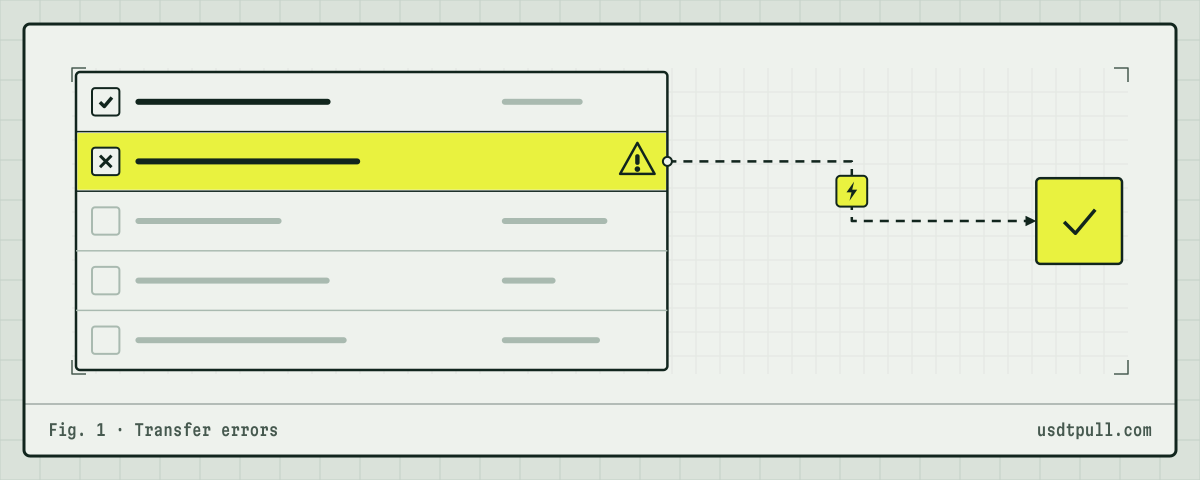
OUT_OF_TIME and other exceptions: the fee limit is the bill
Our sample had no OUT_OF_TIME. The code matters when you call other contracts: an exception burns the whole budget, and the fee limit sets it.
Model calculation at 100 SUN per unit of energy, sender holding 200 TRX:
| Situation | Energy budget | REVERT like dca6d1f0 | OUT_OF_TIME or another exception |
|---|---|---|---|
| No energy, fee limit 100 TRX | min(2,000,000; 1,000,000) = 1,000,000 | 0.8624 TRX | 100 TRX burned |
| No energy, fee limit 15 TRX | 150,000 | 0.8624 TRX | 15 TRX burned |
| 65,000 energy on the address, fee limit 15 TRX | min(2,065,000; 150,000) = 150,000 | 0 TRX | 65,000 energy used and 8.5 TRX burned |
Bandwidth comes on top. Energy already on the address counts inside the cap, so set the fee limit from the full estimate. Why wallet fee estimates differ shows how wallets pick that figure.
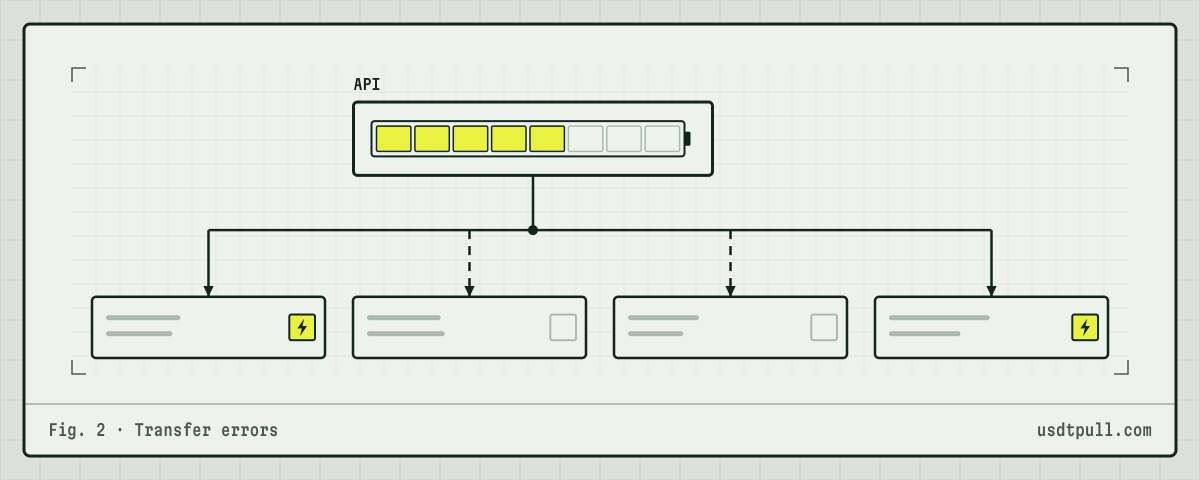
Failed in a block or never in a block
| Failed in a block | Not in a block | |
|---|---|---|
| Hash on tronscan.org | Found, with a result code | Not found |
| USDT | Still with the sender | Still with the sender |
| Cost | Bandwidth, plus energy as above | Nothing |
| Typical cause | Contract refusal, no resources | Expired, or rejected at broadcast: SIGERROR, BANDWITH_ERROR, TRANSACTION_EXPIRATION_ERROR, TAPOS_ERROR |
Per the broadcast errors page, a broadcast without an error is not proof of success; only the receipt is. How long a transaction can wait before it expires is measured in how long a USDT TRC-20 transfer takes.
After a failure:
- Read
receipt.resultand decoderesMessagefrom hex. - REVERT: compare the USDT balance with the amount, then check the blacklist status. Energy fixes neither.
- OUT_OF_ENERGY: look at
energy_usage_total. Zero means the address had neither energy nor TRX to burn. - OUT_OF_TIME or another exception: find the cause before calling again.
- Not in a block: confirm the USDT is still there, then sign a new transaction.
Putting energy on an address is shown in the guides.
FAQ
Is a failed USDT transfer refunded? The USDT never left. Energy and bandwidth spent on the attempt are not refunded.
Why did my failed transfer cost 0 TRX? Resources already on the address covered it, or the address had too little TRX to burn anything, as in the 15 cases above.
Does REVERT always mean an insufficient balance? No. On USDT it can also mean a blacklisted sender or a paused contract. On our receipts the balance case used 8,624 energy and the blacklist case 4,466.
Can I resend the same signed transaction? Not after it failed in a block: that hash is used. Sign a new one. More answers are in the FAQ.